Let’s not sugar coat it. The Bible claims:
- A talking donkey
- Supernatural beings walking among men
- The sun stood still in the sky
- The sun went backwards
- A hailstorm of ‘fire and brimstone’ that consumed two wicked cities
- A woman was turned into a pillar of salt
- A man was swallowed by a sea creature and spit up – alive – three days later
- etc. etc.
- And the whole Bible starts off with this entire universe being created by God commanding it with His spoken word
These (and many more like them) are outstanding claims to make. But let’s not sugar coat it. If you don’t believe it, be honest. You’ll save yourself years of doubting and living as a half-hearted Christian.
Test the Bible and find out if it is trustworthy.
Because if you believe it, Jesus will change your whole life. But the worst thing you can do is to treat it like so many modern people do: like it’s Aesop’s Fables – colourful stories with some powerful moral lessons.
If you do that, you’ll learn the lingo and how to play the part, but miss out on the power of God’s spirit at work in your life to create a fountain of living water bubbling up into a spring of eternal life. Eventually, you’ll admit that it’s dry and lifeless.
This is why: “Jesus stood and said in a loud voice, ‘Let anyone who is thirsty come to me and drink. Whoever believes in me, as Scripture has said, rivers of living water will flow from within them.’ By this he meant the Spirit, whom those who believed in him were later to receive.” The Living God, who formed you, wants to be in relationship with you and transform you by the Holy Spirit at work in you. Being stubborn will shut Him out of your life, but sincerely and humbly investigating the word of God for yourself will bring life. So investigate sincerely.
The question of “Is the Bible reliable?” has some distinct parts to it:
- Is it historically reliable? (ie. is it the same today as it was when it was written)
- Is it historically authentic? (ie. was it written when it claims to have been written)
- Is it internally consistent? (ie. does it agree with itself)
- Is it externally consistent? (ie. does it agree with the rest of known history)
- What about ‘outlandish’ claims that it makes (like a talking donkey)?
Is the Bible historically reliable?
(ie. is it the same today as it was when it was written)
Mike Winger addresses this topic well on his website and YouTube channel.
In summary: there is more textual evidence for the Bible than there is for any other ancient text. There are more than 5000 Greek manuscripts, of all or portions of, the new testament totalling over 1 million pages of text. Including other languages, there are about 20,000 manuscripts of the new testament.

You can look at the scans of them for yourself at The Center For the Study of New Testament Manuscripts.
Besides the manuscripts of the new testament itself, there are numerous quotations of the text itself in the writings of the early church fathers.
Besides textual evidence derived from New Testament Greek manuscripts and from early versions, the textual critic has available the numerous scriptural quotations included in the commentaries, sermons, and other treatises written by the early Church fathers. Indeed, so extensive are these citations that if all other sources for our knowledge of the text of the New Testament were destroyed, they would be sufficient alone for the reconstruction of practically the entire New Testament.
Metzger and Ehrman, The Text of the New Testament, 126.
In this significant number of manuscripts, there are textual variants. These variants can be separated into various categories:
- Variants that are not meaningful or viable (like spelling errors that are obvious, but have no effect on the meaning)
- Variants that are meaningful but not viable (errors that would affect the meaning, but are clearly mistakes – about 25%)
- Variants that are meaningful and viable (about 1% – and none of them affect an essential christian doctrine)
It’s the last category of variants that most effort is spent on; reviewing the available texts to determine what was originally written. Mike Winger again covers this well.
Because of the painstaking work of thousands of writers, copyists, and scholars, through thousands of years, you can read the Bible and confidently know that you are reading the preserved word of God. Nothing that matters is at risk in these variants. In fact there’s overwhelming evidence that the Bible you read today is carefully preserved and the theology, doctrine, and the historical record preserved in the Bible are a solid rock and firm foundation to build your life on.
Is the Bible historically authentic?
(ie. was it written when it claims to have been written)
Investigate the historical record for yourself. We live in an age where immense amounts of facts and evidence are available. Like never before in history, the average person can look up volumes of ancient texts from the comfort of their own home on a leisurely Saturday morning. The facts are not far away, so spend some time to investigate.
But remember this one thing: you could spend your whole life investigating if the Bible is reliable, and your life wouldn’t change; Satan would be thrilled for you to be stuck in a fruitless debate of being either an intellectual skeptic or an intellectual believer. The enemies of God already know the truth, but they don’t listen to and obey the God who instructs them how to live. Knowing the Bible is true is not the same as hearing God’s instructions to you, accepting God’s authority, and then doing what He says. Get to know Him by believing His word and saying “God, your word says I am not the way you ask me to be. Please change me.”
Like all topics about the reliability of scripture, this topic is hotly attacked by many. Don’t take anyone’s word for it, investigate for yourself.
Here’s one of the most classic examples of a critique that “requires” the gospels to have been written later. Matthew, Mark, and Luke (Matthew less obviously) discuss Jerusalem surrounded by armies. Since this didn’t happen until just before the destruction of Jerusalem by the Romans in 70 AD, the gospels “must” have been written after 70 AD. Obviously the question here is not about the text, but about whether the Bible can actually contain prophecy. If it is a natural, human, book it must have been written after 70 AD; on this we agree. If it is a natural human book, save yourself the time and don’t bother reading it. But if it is the unique word of God (unlike other religious texts) then it certainly can (and does) contain prophecy. For example, consider Isaiah chapter 53. The dead sea scrolls irrefutably demonstrate that the text of Isaiah existed hundreds of years before Jesus. Isaiah contains such a clear prophetic picture of the ultimate work of Jesus:
But he was pierced for our transgressions,
Isaiah 53:5-6
he was crushed for our iniquities;
the punishment that brought us peace was on him,
and by his wounds we are healed.
We all, like sheep, have gone astray,
each of us has turned to our own way;
and the Lord has laid on him
the iniquity of us all.
Paul had to have written all his works before he died, and everyone agrees he was dead by 70 AD. Paul quotes the words of Jesus in Luke as scripture in 1 Timothy 5:18b.
In 2 Peter 3:16, Peter refers to the letters from Paul that were circulating around the church, and calls them scripture. Peter was also dead by 70 AD.
Written in about 95 AD, 1 Clement 42:1-2 “The apostles [the disciples of Jesus] received the gospel for us from the Lord Jesus Christ, Jesus the Christ who was sent from God. The Christ therefore is from God and the apostles from Christ.” Here’s a first century witness speaking to an established church about the gospel they received from the disciples of Jesus.
(The counter argument is that this reference to the “gospels” is not the written gospels, but instead a verbal or traditional “gospel”. This ignores the point, that Clement was writing to a body of established churches who already knew what the gospels are before the turn of the century.)
Ignatius, an early church father, by 110 AD had quoted from 25 of the 27 new testament books.
Even if you put aside the reasons that the new testament was written early on, and the critics are granted most of their arguments, we still have strong evidence that the gospels were in circulation by about 150 AD. Again, this is better evidence and history than any other ancient text. If this isn’t good enough, then there are no historical documents we can trust. Those other texts aren’t challenged and attacked to a degree anything like what the Bible receives. Why? Read the whole Bible and see for yourself. It is the word of the living God convicting you of sin, and calling you to turn your heart back to God, turn away from sin and rebellion, and to ask God – our Father and creator – to forgive us and make us new. Together, these things are called ‘repentance’. The Bible invites you to be re-united with God your Father though humble repentance. This central message is present from cover to cover, and is offensive to everyone who won’t humble themselves. A common defence is to attack the credibility of the Bible to a level that no other ancient record receives.
Is the Bible internally consistent?
(ie. does it agree with itself)
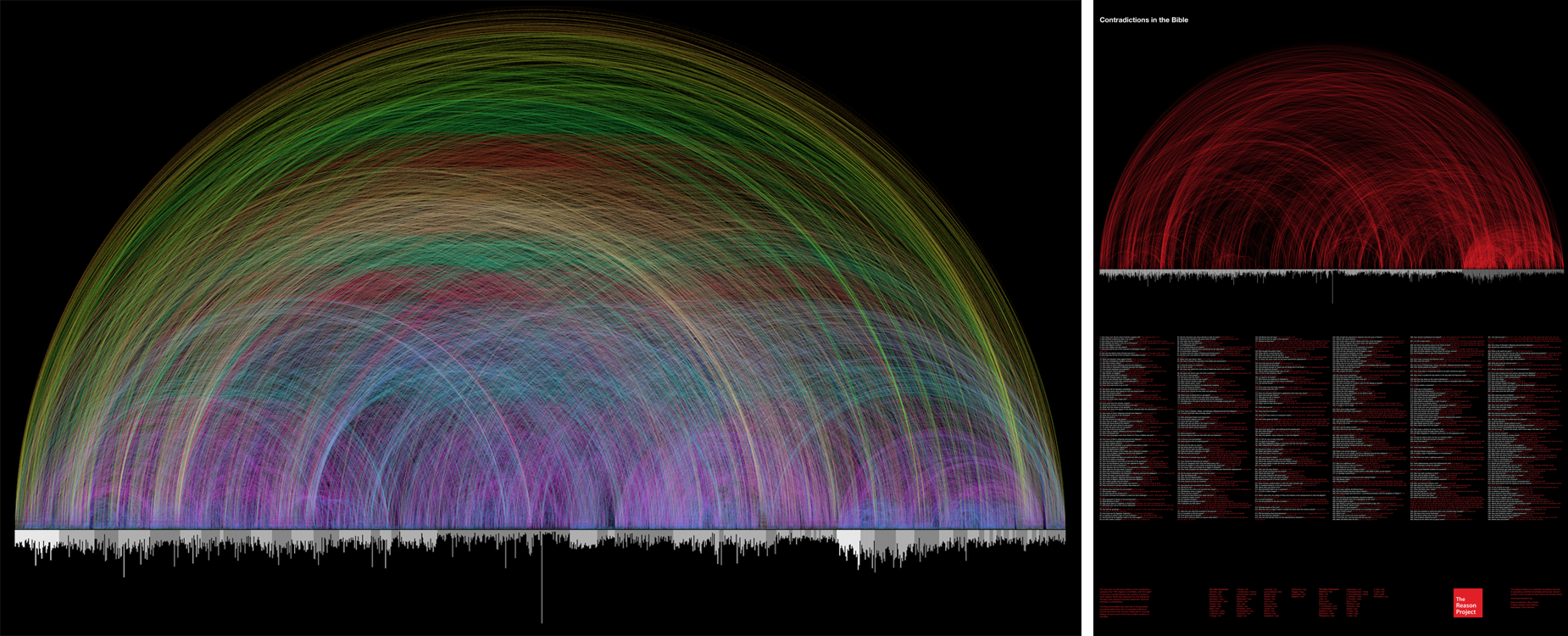
A tale of two rainbows. A while back, Chris Harrison built this visualization showing the (63000+) internal cross-references in the Bible (check out his website). In 2009, Andy Marlow used this as inspiration and created a “Bible Contradictions Rainbow” for Sam Harris’ Reason Project. The high resolution version of it (where you can actually read the text) is gone from the web, and so is the Reason Project. Most of the things listed as “contradictions” are simple things that take minimal study (e.g. a person or place has two names, just like people and places do today). There are some on the list that do require some effort in study to understand, but none of them are beyond reach of reasonable and satisfying answers.
Try this exercise with your kids (or borrow 3-4 nieces or nephews). Adapt for adults if needed. Tell them that they are historians and they need to record the events they’re about to hear. Tell them a 5 minute story, or read them a short story book (even better if there are pictures). Then split them up into different rooms, and give them paper and a pencil and ask them to write down a record of what they heard. You’ll see there’s a difference between having 3-4 different perspectives on the same events, and having “contradictions”. When real people write down a record of events, each person writes from a different perspective.
When you read these different accounts of the same events you need to spend some time and effort to piece these perspectives together to understand the full record of what really happened. That’s the same effort that you should spend when you read and study the Bible. Most of the assertions of “contradictions” are because of this issue. Many more of them are arguments from silence – a certain detail is not recorded, we read into that space an assumption, and then show it as a contradiction. Many times we read into the text our modern, western, patterns of thinking, speaking and writing. Many things asserted as “contradictions” are clarified and understandable when we read the text in the original language, culture, and context. This sometimes requires a reasonable amount of effort.
It’s worth the effort. Spend that effort searching for truth, hope, and love, instead of looking for “gotchas” and this will be an investment that brings you life. Each item on a list of contradictions deserves individual time and study in proportion with each item on the list of internal cross references. Test your motives. Spend equal time and effort studying the internal confirmation of scripture from cover to cover as you do studying the claimed “contradictions”. While most that I’ve investigated are trivial, or clear misunderstandings, some require deep investigation. They all have satisfying conclusions, but some have very revealing conclusions. Often, I’ve learned that the way I read the Bible is not the way I was meant to read it, and at the heart of the apparent “contradiction” is something I can learn about what the writer was trying to convey to the audience in that culture, language, and context that otherwise I would never understand or learn from.
Mike Winger has done a 3-video series on this topic.
An example “contradiction”
On this page I’ll address only one example that highlights how we can read into the text something from our culture. The modern secular approach to Genesis chapter 1 and 2 is the claim that they are two separate creation accounts that were merged together at some point in history. The underlying proposal is that the Bible is a hybrid of two (some say up to four or more) preexisting religions, and here in Genesis 1 and 2 two separate creation belief systems are woven together by an unnamed ‘redactor’.
Read the two chapters. Let’s focus on 2:4: “This is the account of the heavens and the earth when they were created, when the Lord God made the earth and the heavens.” The assertion is that there’s a second creation account beginning here. If you read the rest of chapter 2 with this lens, it can appear that way.
In lots of modern English Bibles, there’s a heading break right right before verse 4. This heading subtly implies that there’s a separation between verse 3 and 4. But here’s the thing, these headings don’t exist in the text of scripture. They’re there to help you have context and to provide the structure that a modern reader expects. Neither do the chapter and verse numbers exist in the text of scripture. We’ve added them to help us discuss and reference scripture the way we’re used to in our modern cultures. Some Bible versions have moved that heading from between verse 3/4 to between the two sentences in verse 4, to help clarify. This shift makes the first half of verse 4 seem like a conclusion of chapter 1. That’s fine, but the key is to remember that all the headings in your Bible are not part of the text of scripture. Once I learned this, I stopped reading each chapter and verse as separate disconnected statements. There are several examples where the modern divisions of headings, chapters, and verses causes us to miss a lot of what the writer was saying. (e.g. end of Gen ch. 8 to beginning of Gen ch. 9, and end of Isaiah 52 to beginning of Isaiah 53)
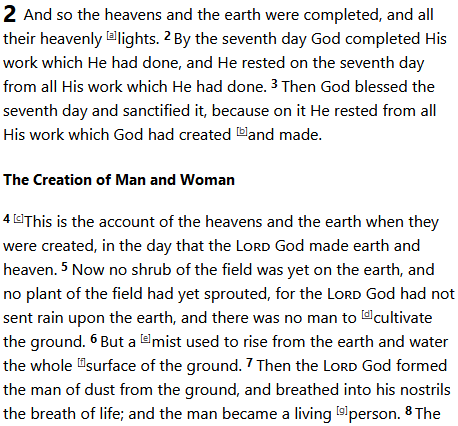
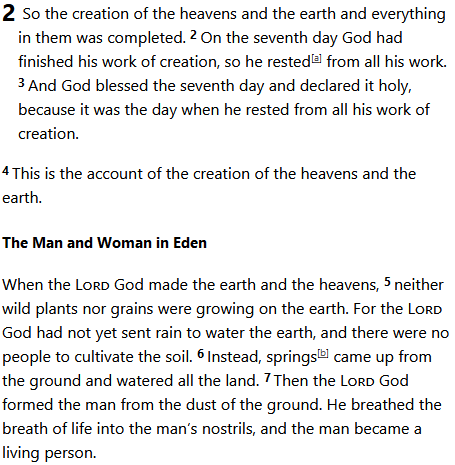
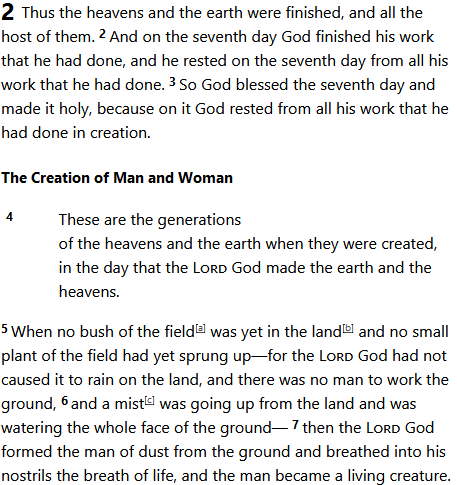
The key takeaway here is that in any translation between two languages, the meaning doesn’t come straight across, and there are always choices to make, so it’s important to study the Bible in several translations. Ideally, we’d all learn ancient Hebrew. But reading the Bible in multiple reliable translations is important to understand something closer to the meaning of the original language.
Another important note is how the culture of the writer and reader is different. In the middle-eastern culture today, the way people talk, write, and teach is different than the way we do in the west. In the west when we write an account of an event, we tend to write chronologically and literally. This is ok, but in the middle east they write more thematically. The western mind might document more of the ‘who’, ‘what’, ‘where’, and ‘when’, while the eastern writer would most likely use those things mostly as a backdrop for the ‘why’. It’s not that the facts don’t matter or are only metaphorical, it’s that the facts matter because of their connection to the purpose of the passage. When we westerners read this style of writing we may discount it as a metaphorical only. But the writers of that time most likely had no such distinction. The facts are not there to exist on their own, but to point to a certain purpose. Just because they point to a purpose doesn’t mean they’re not factual.
So what’s the thematic point of Genesis chapter 1? It’s not just to document a series of facts. It’s to teach us things like: God existed before creation, it was God who created, He spoke everything into existence, He made us in His image, He made us to rule over this earth and the things in it, and it was good (x7).
So what’s the thematic point of Genesis chapter 2? It’s not just to document a series of facts in a different chronological order. It’s to teach us things like: Before God created man to care for His perfect creation God still watered it with mist or dew, that God breathed into man and he became a living person, that God commanded man to do certain things and to not do others, that God gives man work to do, and that it’s not good for man to be alone and he needs a helper, and that a man should leave his father and mother and be united to his wife becoming one flesh.
Genesis chapter 1 is clearly a chronological account of creation. But the writer clearly wanted to communicate something more than the chronology in chapter 2. These are not two separate accounts, but the same events told again with a different thematic purpose. Having grown up in the Middle East, I can tell you first hand, repetition is common in that culture today. Repetition is used to underline and emphasize important points (sometimes from a different perspective, just like Genesis 1&2) to make sure the listener gets the point.
Also, in ancient Israel chapter and verse numbers did not exist. So how would they reference scripture? They memorized it from the time they were young. Then they would quote one line from a passage, and the line they quoted was meant to bring to mind the whole message and theme of that portion of scripture. The line quoted is a reference to the concept from that passage, as much as it’s a reference to those words. After I learned this it transformed how I read the new testament. It’s full of references to the old testament, and the concepts the new testament writers pull on are much, much, richer than just the words they quote.
Is the Bible externally consistent?
(ie. does it agree with the rest of known history)
You may notice a pattern in Biblical criticism: As the evidence comparing the text of the Bible to the historical record outside the Bible gets more abundant and clear, the criticisms get more specific. There are many people groups and nations mentioned in the Bible that scholars used to say “they probably never existed”, until evidence of them is discovered in archaeology or ancient literature from other nations. They used to question the existence of the early nation of Israel, then they questioned the existence of King David, then when both are proven archaeologically, they get more specific: “sure, there may have been a nation, and it may have had a King David, but he wasn’t that big a deal, and the nation wasn’t what they say it was.”
Take Isaiah the prophet and King Hezekiah. Skeptics suggested neither of them actually existed, until archaeological evidence was found for both of them within a few feet of each other – exactly as you’d expect from the Biblical text. Then the criticisms get more specific: “Well, they may have existed, but that doesn’t mean they did those things and said those things.”
We have external evidence of Isaiah the prophet from the right place, at the right time (about 700 BC), and a written record of the things he said. The historical events recorded in the book of Isaiah can be externally confirmed in the archaeological evidence from Assyria. Search the rest of history from that time period for such a clear confirmation of any other writings. For some people, no amount of evidence is enough. Be careful who you listen to. Don’t let voices hold authority in your mind if they have decided to never believe regardless how clear the evidence is.
So, here’s the best advice: you investigate for yourself, don’t take anyone’s word for it.
While I believe the answer to the question is clear – yes, the Bible is externally consistent, meaning it is consistent with the remainder of recorded history – it is critical to keep two things in mind:
- Proof – Evidence is not the same as ‘proof’. Let’s imagine two people, say, a Bible author in the Old Testament and Sennacherib king of Assyria, both record a substantially congruent history of the events of a certain time (albeit from different perspectives), this does not prove anything. Just because two people tell a similar story does not mean it actually happened. They both could have made it up (out of necessity, convenience, or conspiracy).
When comparing the history recorded in the Bible to the remainder of recorded history, there is a large volume of compelling information that demonstrates that the Bible is consistent with the balance of recorded history. But those who claim they just need ‘proof’ will probably never be satisfied. Those that are honestly searching and honestly testing, to see if the Bible is worth putting your trust in, you can rest assured that it is a solid rock, and a firm foundation to build your life on. Test it for yourself. - More importantly, the facts of the Bible that we can test in history and archaeology are mostly, with few important exceptions, secondary things that have nothing to do with the primary claims of the Bible.
The primary claims of the Bible are:- It is the Word of God, inspired by the Holy Spirit, written by humans
- God has the authority to direct us to act in a certain way, through His instructions written in the Bible
- God created the universe and everything in it
- God created it perfect
- We (humanity) rebelled at the beginning and have continued rebelling against God to this day
- The consequence of our sin (ie. rebellion, ie. doing what we decide instead of what God has instructed) is corruption and death for us and corruption and death for the creation around us
- Jesus was God in the flesh, was born of a virgin, and lived a sinless, perfect, life
- Jesus died for our sin not His own, carried our sin on Himself down to the grave, but because He was sinless God raised Him to life again on the third day
- Jesus ascended to the Father and is seated at His right hand, preparing a home for us
- God’s requirement of all who live today is to confess our sins, turn from sin, and to ask Jesus to forgive us and wash us clean and make us new; And to believe that the only reason we can be saved is because Jesus died for us and God raised Him from the dead.
- Human rebellion will continue until it reaches it’s climax in a fake utopia that claims peace but will be the most evil days the earth has seen
- At that time Jesus will return to judge the whole earth, and dispense perfect justice
- He will put an end to the rebellion, and set up the first truly righteous kingdom this world has ever seen
- Only those who are washed by the blood of Jesus will enter into His eternal rest when He comes into His kingdom
- Those who remain in rebellion will enter eternal torment
- Why does God wait so long between evil being perpetrated and justice being dispensed? Because we are all guilty, and His desire is that no one would die, and that all would accept His gracious gift of forgiveness through the death of Jesus, and enter into eternal life.
So, the question of “Is the Bible externally consistent” is best answered by testing the primary claims, not secondary claims. That’s what the rest of this website is about. Get to know the only God, the one who made you, as He describes Himself and not how others claim Him to be. God doesn’t owe us anything, but He longs to restore us to right relationship with Him. Ask the God who formed you from the dust to reveal Himself to you, pick up the Bible and listen to His word to you.
Taste and see that the Lord is good; blessed is the one who takes refuge in him.
Psalm 34:8-14
Fear the Lord, you his holy people, for those who fear him lack nothing.
The lions may grow weak and hungry, but those who seek the Lord lack no good thing.
Come, my children, listen to me; I will teach you the fear of the Lord.
Whoever of you loves life and desires to see many good days, keep your tongue from evil and your lips from telling lies.
Turn from evil and do good; seek peace and pursue it.
What about ‘outlandish’ claims that it makes (like a talking donkey)?
Let’s be clear: do not believe the Bible because you can intellectually assent to it’s authenticity and reliability. James, the brother of Jesus, put it like this : “You believe that there is one God. Good! Even the demons believe that—and shudder.” (in James chapter 2)
It matters a lot that the Bible is authentic, accurate, and reliable. If it’s not true, then it’s just an emotional experience that’s not based on the truth – it’s a delusion. But it’s more important that you believe God’s commands to you personally and, because you believe, that you do what He asks. The Bible is, from cover to cover, God revealing Himself to you, and how He expects you to relate to Him and the other people in your life.
If you stop at merely accepting the Bible as historically authentic, accurate, and reliable you’ll stop short of the only thing that matters: that you know God; the infinite God of the universe who created you and everything else. The God who humbled Himself to the point of death so that you could know Him. He loves you, and wants you to know Him.
Knowing God requires both A) the intellectual assent to God’s word, His will, and His authority, and B) the emotional relationship; that you know Him directly and intimately. That He is your bread of life, and your living water. That anything you need you find in Him. He’s your father, your King, your Lord and master, your saviour, your provider, your protector, your peace, your strength, your song, your teacher, anything else you need, and your friend.
Beginning a relationship like that requires that you face the reality of the situation: the Lord is God, and I am His creation.
Don’t make the mistake of expecting God to submit to your intellect. Don’t make the similar mistake of deciding that there’s room for God in your intellect. Instead accept that to fully describe the infinite, all-powerful, God of creation would require volumes of books beyond comprehension. God has revealed enough to us that we can make an accurate decision to believe Him or reject Him.
You can’t really expect to get to know the infinite all-powerful God who made you when you expect Him to only do things that you decide are rational. He sets the terms of the relationship. He will do as He chooses. If someone is looking for a god who only does what our finite intellect can accept, then that’s a fake god they’re looking for; a god subject to the human mind.
Who has measured the waters in the hollow of his hand, or with the breadth of his hand marked off the heavens?
Isaiah 40:12-14
Who has held the dust of the earth in a basket, or weighed the mountains on the scales and the hills in a balance?
Who can fathom the Spirit of the Lord, or instruct the Lord as his counsellor?
Whom did the Lord consult to enlighten him, and who taught him the right way?
Who was it that taught him knowledge, or showed him the path of understanding?
Surely the nations are like a drop in a bucket;
they are regarded as dust on the scales;
he weighs the islands as though they were fine dust.
For the word of the cross is folly to those who are perishing, but to us who are being saved it is the power of God. For it is written,
“I will destroy the wisdom of the wise,
and the discernment of the discerning I will thwart.”Where is the one who is wise? Where is the scribe? Where is the debater of this age? Has not God made foolish the wisdom of the world? For since, in the wisdom of God, the world did not know God through wisdom, it pleased God through the folly of what we preach to save those who believe. For Jews demand signs and Greeks seek wisdom, but we preach Christ crucified, a stumbling block to Jews and folly to Gentiles, but to those who are called, both Jews and Greeks, Christ the power of God and the wisdom of God. For the foolishness of God is wiser than men, and the weakness of God is stronger than men.
For consider your calling, brothers: not many of you were wise according to worldly standards, not many were powerful, not many were of noble birth. But God chose what is foolish in the world to shame the wise; God chose what is weak in the world to shame the strong; God chose what is low and despised in the world, even things that are not, to bring to nothing things that are, so that no human being might boast in the presence of God. And because of him you are in Christ Jesus, who became to us wisdom from God, righteousness and sanctification and redemption, so that, as it is written, “Let the one who boasts, boast in the Lord.”
1 Corinthians 1:18-31
Paul summarizes, above, that ‘the world did not know God through wisdom’, so it pleased God to save those who believe that Jesus was both man and God, that He died for your sins, and was raised from the dead. And this is the most ‘outlandish’ claim of all. If we can’t accept that God can do whatever God wants to do, then we won’t accept that He really died in our place.
The most ‘outlandish’ claim of all:
God Himself loves you. He created you to be His friend – not an autonomous robot, but a living person with a free will. Using that free will we have rejected Him, and accused Him of injustice and holding Himself back from us. He loves you so much that He gave up everything to restore the relationship. Even though He is God and sovereign over everything, He put aside his glory and put on flesh. He was born as a human in the most humble circumstances. He humbly lived a perfect life in this evil world. He loved and taught people. He was crucified and died for your sin. Because He had never sinned He was raised again on the third day. He defeated the power of sin and death. He offers to you the ability to receive His victory over sin and death through the power of His blood as a perfect substitute for your sin. He offers you a new life filled by the power of His Holy Spirit at work in your life. And one day He will raise you up from the grave with a new body to live with Him forever. When the evil of this world has reached it’s full maturity, and is clearly evident as evil, He will return to this earth as the King of Kings. He will do away with the evil rulers and authorities of this world and will set up the first truly righteous kingdom earth has ever seen.
Mike Winger has a video on the evidence for the resurrection, and a follow up to the criticisms against that evidence.